 PyLops Benchmarks
Seismic interpolation#
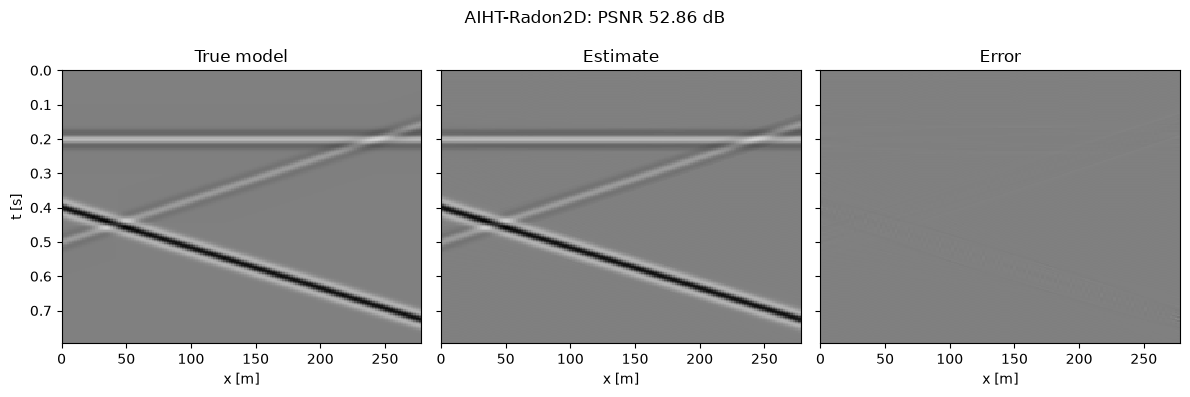
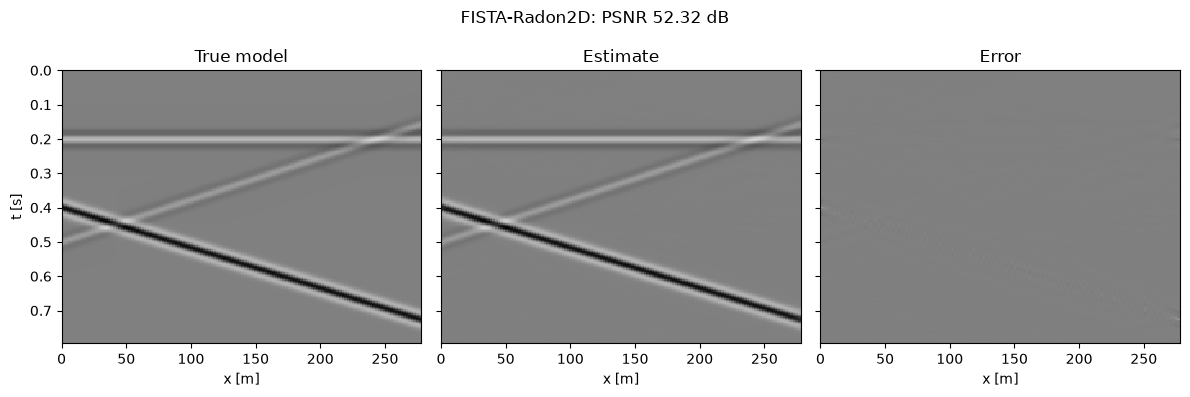
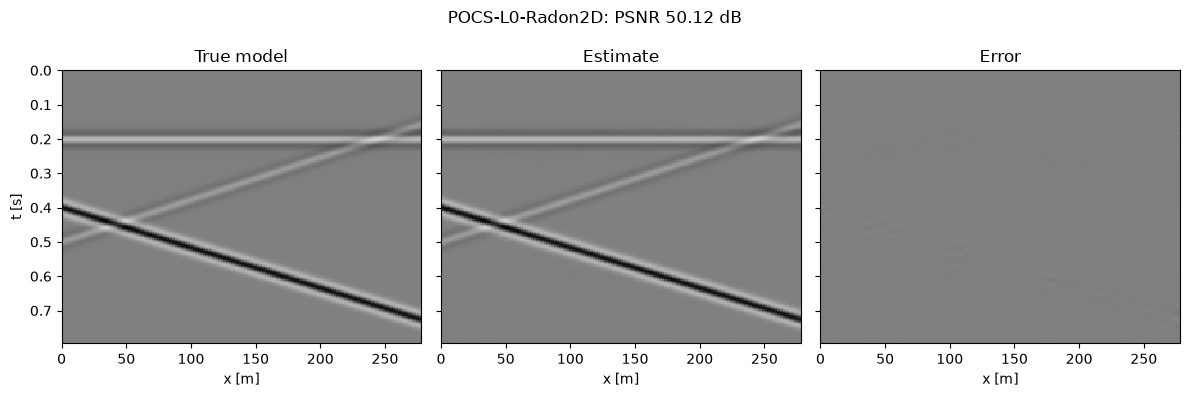
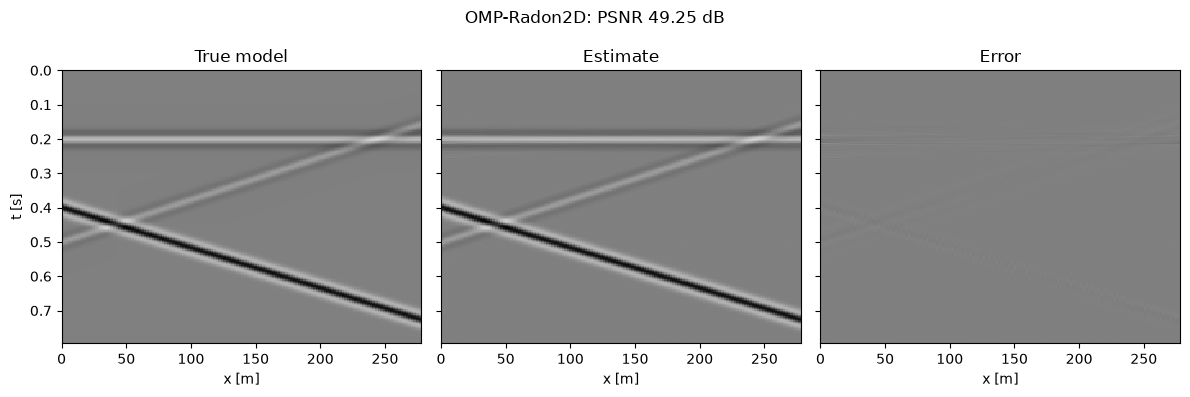
Reconstruction of a 2D seismic gather from a random subset of its traces.
True model: the fully sampled gather.
Operator:
pylops.Restrictionalong the spatial axis, keepingperc_subsamplingof the traces (selected with a fixedseed).Data: the restricted gather, plus optional white Gaussian noise (
noise_std, also drawn with a fixed seed).
Solvers compared:
Solver |
Formulation |
|---|---|
|
Regularized least squares with a second derivative along the spatial axis, solved with LSQR |
|
L1 sparsity-promoting inversion in the f-k domain (2D FFT as preconditioner), solved with FISTA with a decaying sparsity weight |
|
L1 sparsity-promoting inversion in the linear Radon (tau-p) domain, solved with FISTA with a decaying sparsity weight |
|
Greedy L0 inversion in the linear Radon domain, solved with Orthogonal Matching Pursuit |
|
L0-regularized inversion in the linear Radon domain, solved with Accelerated Iterative Hard Thresholding (PyProximal) with a decaying sparsity weight |
|
L0-regularized inversion in the linear Radon domain with exact data consistency, alternating hard thresholding with a decaying sparsity weight and projection onto the data-consistent affine set (PyProximal HQS) |
|
Greedy L0 inversion in the f-k domain, solved with Orthogonal Matching Pursuit |
|
L0-regularized inversion in the f-k domain, solved with Accelerated Iterative Hard Thresholding (PyProximal) with a decaying sparsity weight |
|
L0-regularized inversion in the f-k domain with exact data consistency, alternating hard thresholding with a decaying sparsity weight and projection onto the data-consistent affine set (PyProximal HQS) |
All Radon solvers use the same dictionary, pylops.signalprocessing.FourierRadon2D
with a linear kernel. All f-k solvers use pylops.signalprocessing.FFT2D (adjoint)
as the dictionary, with the restriction operator rebuilt in complex dtype and the
real part taken after it.
Source: benchmarks/seismic_interpolation.
Results#
Raw results: results/seismic_interpolation.csv.
Linear events#
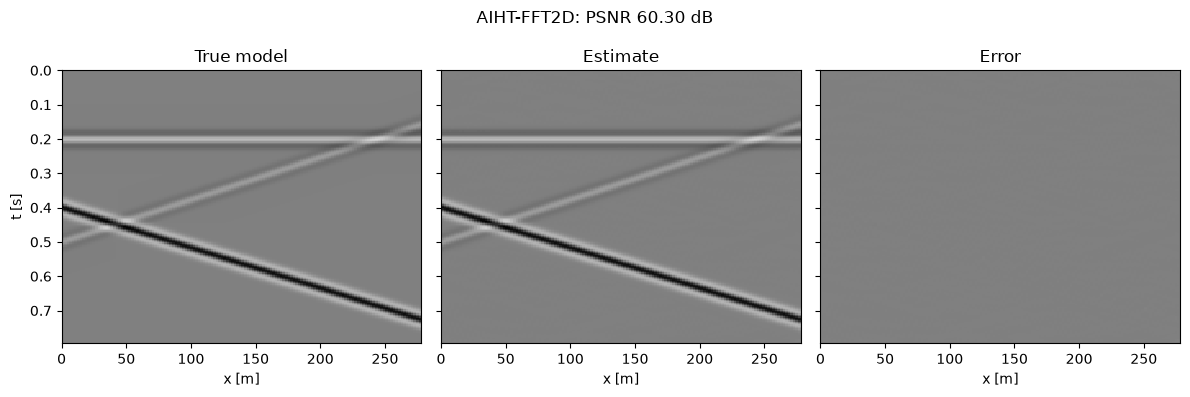
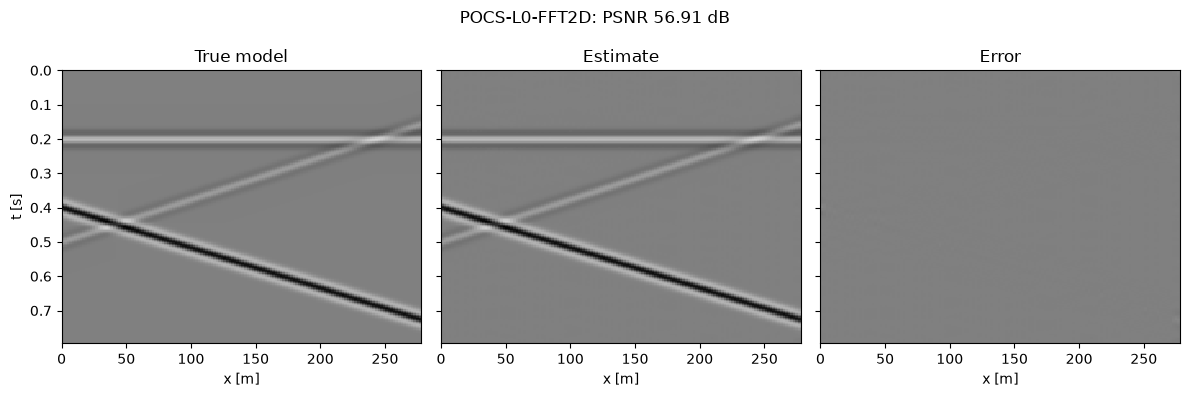
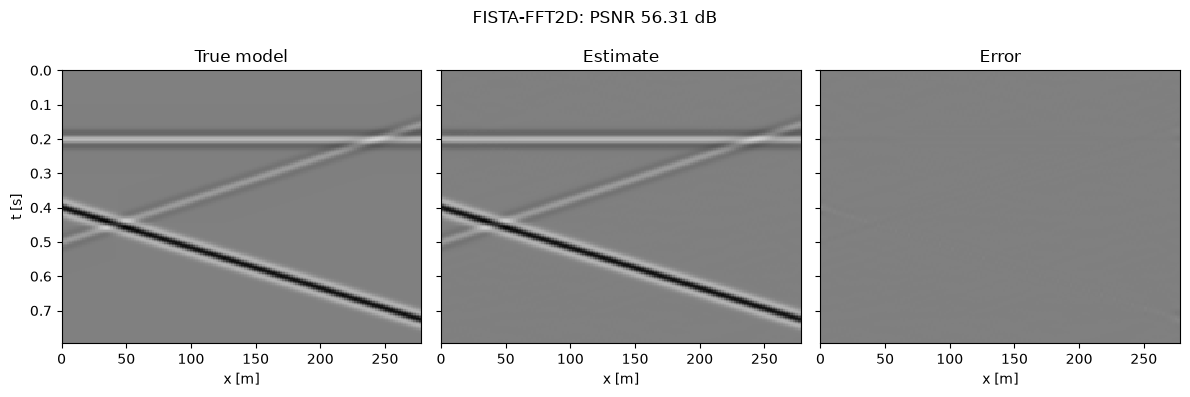
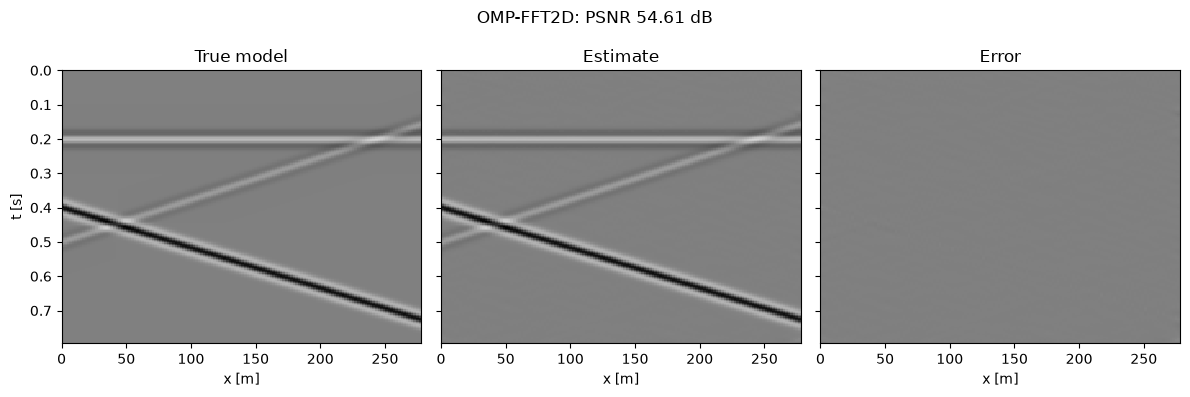
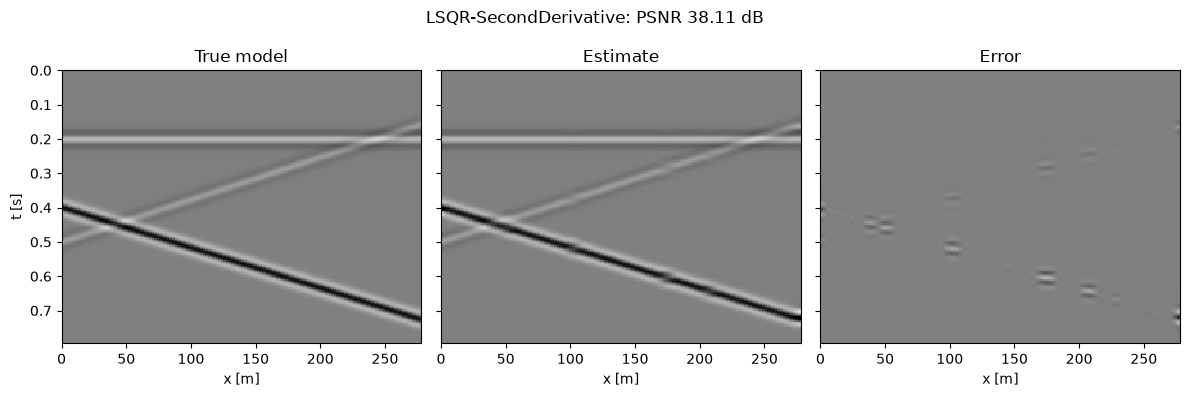
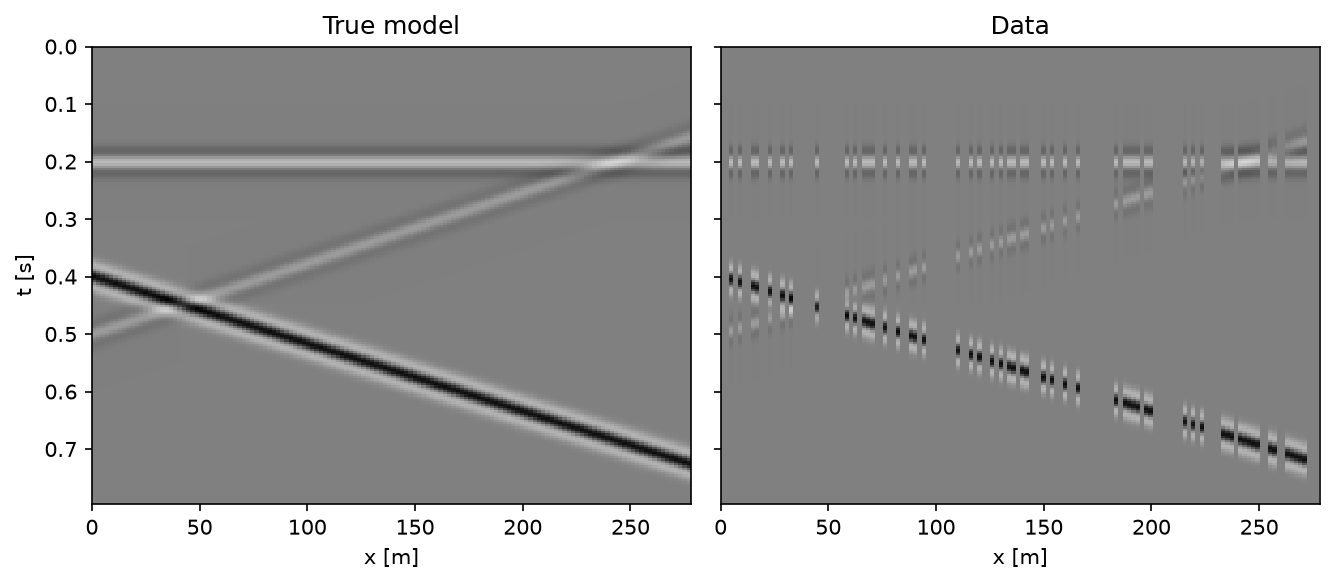
2D gather with three linear events, randomly subsampled in space.
The gather has 140 traces (2 m spacing) and 200 time samples (4 ms sampling). It contains three linear events with intercept times 0.2, 0.4 and 0.5 s, angles 0, 70 and -80 degrees (velocity 800 m/s) and amplitudes 1, -2 and 0.5, all with a 20 Hz Ricker wavelet.
Dataset parameters: noise_std=0, perc_subsampling=0.4, seed=42
Rank |
Solver |
MAE |
PSNR [dB] |
Time [s] |
Figure |
|---|---|---|---|---|---|
1 |
0.002455 |
60.30 |
12.700 |
||
2 |
0.002462 |
56.91 |
20.665 |
||
3 |
0.002373 |
56.31 |
18.507 |
||
4 |
0.00454 |
54.61 |
23.115 |
||
5 |
0.004103 |
52.86 |
43.547 |
||
6 |
0.003084 |
52.32 |
33.120 |
||
7 |
0.008483 |
50.12 |
161.054 |
||
8 |
0.005183 |
49.25 |
84.902 |
||
9 |
0.007563 |
38.11 |
0.069 |