

Note
Go to the end to download the full example code.
Reflectivity Inversion - 3D#
This is a follow up of the Post Stack Inversion - 3D tutorial. The same seismic data will be considered, however instead of inverting it for an absolute impedance model the reflectivity is targetted.
In other words, the modelling operator becomes
where \(\text{r}(t)\) is the reflectivity profile and \(w(t)\) is the time domain seismic wavelet. Similar to the other example, being this inherently a 1d operator, we can easily set up a problem where one of the dimensions (here the y-dimension) is distributed across ranks and each of them is in charge of performing modelling for a subvolume of the entire domain.
However, since a reflectivity model is sparse, a sparsity-promoting solver is used here.
We will consider two options:
- pylops_mpi.optimization.ISTA: ad-hoc distributed ISTA solver
acting like PyLops’ ISTA;
pylops_mpi.proximal.optimization.ProximalGradient: general purpose distributed Proximal Gradient solver acting like PyProximal’s ProximalGradient;
import numpy as np
from matplotlib import pyplot as plt
from mpi4py import MPI

import pyproximal
from pylops.utils.wavelets import ricker
from pylops.basicoperators import FirstDerivative
from pylops.signalprocessing import Convolve1D

import pylops_mpi

plt.close("all")
rank = MPI.COMM_WORLD.Get_rank()
size = MPI.COMM_WORLD.Get_size()
Let’s start by defining all the parameters required by the
pylops.avo.poststack.PoststackLinearModelling operator.
# Model
model = np.load("../testdata/avo/poststack_model.npz")
x, z, m = model['x'][::3], model['z'], np.log(model['model'])[:, ::3]

# Making m a 3D model
ny_i = 20  # size of model in y direction for rank i
y = np.arange(ny_i)
m3d_i = np.tile(m[:, :, np.newaxis], (1, 1, ny_i)).transpose((2, 1, 0))
ny_i, nx, nz = m3d_i.shape

# Size of y at all ranks
ny = MPI.COMM_WORLD.allreduce(ny_i)

# Wavelet
dt = 0.004
t0 = np.arange(nz) * dt
ntwav = 41
wav, _, wavc = ricker(t0[:ntwav // 2 + 1], 15)

# Collecting m3d at all ranks
m3d = np.concatenate(MPI.COMM_WORLD.allgather(m3d_i))
We now create the linear operators to model the data (including a time derivative as in the post-stack tutorial) as well as that to invert the data for the underlying reflectivity model.
# Create flattened model data
m3d_dist = pylops_mpi.DistributedArray(global_shape=ny * nx * nz)
m3d_dist[:] = m3d_i.flatten()

# LinearOperator Derivative + Convolve
Dop = FirstDerivative((ny_i, nx, nz), axis=-1)
Cop = Convolve1D((ny_i, nx, nz), wav, offset=wavc, axis=-1)
DDiag = pylops_mpi.basicoperators.MPIBlockDiag(ops=[Dop, ])
CDiag = pylops_mpi.basicoperators.MPIBlockDiag(ops=[Cop, ])

# Reflectivity
r_dist = DDiag @ m3d_dist
r_local = r_dist.local_array.reshape((ny_i, nx, nz))
r = r_dist.asarray().reshape((ny, nx, nz))

# Data
d_dist = CDiag @ r_dist
d_local = d_dist.local_array.reshape((ny_i, nx, nz))
d = d_dist.asarray().reshape((ny, nx, nz))
We now perform sparsity-promotion inversion with the ISTA solver
r0_dist = pylops_mpi.DistributedArray(global_shape=ny * nx * nz)
r0_dist[:] = 0.

rfista3d_dist = pylops_mpi.optimization.sparsity.fista(
    CDiag, d_dist, x0=r0_dist,
    niter=200, eps=2e-2, tol=1e-8, show=True)[0]
rfista3d = rfista3d_dist.asarray().reshape((ny, nx, nz))
FISTA (soft thresholding)
--------------------------------------------------------------------------------
The Operator Op has 2937000 rows and 2937000 cols
eps = 2.000000e-02      tol = 1.000000e-08      niter = 200
alpha = 2.150970e-02    thresh = 2.150970e-04
--------------------------------------------------------------------------------
   Itn          x[0]              r2norm     r12norm     xupdate
     1      -4.5123e-04         2.863e+03   3.378e+03   2.448e+01
     2      -6.4525e-04         1.471e+03   2.052e+03   6.164e+00
     3      -4.0424e-04         8.674e+02   1.496e+03   4.476e+00
     4      -0.0000e+00         5.565e+02   1.215e+03   3.542e+00
     5       7.4901e-05         3.782e+02   1.056e+03   2.938e+00
     6       0.0000e+00         2.690e+02   9.595e+02   2.501e+00
     7      -0.0000e+00         1.982e+02   8.964e+02   2.172e+00
     8       0.0000e+00         1.503e+02   8.516e+02   1.921e+00
     9       0.0000e+00         1.166e+02   8.182e+02   1.725e+00
    10       0.0000e+00         9.216e+01   7.919e+02   1.570e+00
    11      -0.0000e+00         7.412e+01   7.704e+02   1.443e+00
    21      -0.0000e+00         1.886e+01   6.515e+02   8.884e-01
    31      -0.0000e+00         1.213e+01   6.005e+02   6.544e-01
    41      -0.0000e+00         1.016e+01   5.771e+02   5.203e-01
    51      -0.0000e+00         8.928e+00   5.624e+02   4.726e-01
    61      -0.0000e+00         8.137e+00   5.505e+02   4.646e-01
    71      -0.0000e+00         7.296e+00   5.428e+02   4.203e-01
    81      -0.0000e+00         6.926e+00   5.371e+02   3.805e-01
    91      -0.0000e+00         6.644e+00   5.339e+02   3.171e-01
   101      -0.0000e+00         6.626e+00   5.320e+02   2.625e-01
   111      -0.0000e+00         6.528e+00   5.300e+02   2.430e-01
   121      -0.0000e+00         6.487e+00   5.287e+02   2.263e-01
   131      -0.0000e+00         6.415e+00   5.277e+02   2.083e-01
   141      -0.0000e+00         6.440e+00   5.266e+02   2.036e-01
   151      -0.0000e+00         6.468e+00   5.256e+02   2.024e-01
   161      -0.0000e+00         6.475e+00   5.248e+02   1.985e-01
   171      -0.0000e+00         6.505e+00   5.241e+02   1.967e-01
   181      -0.0000e+00         6.518e+00   5.234e+02   1.955e-01
   191      -0.0000e+00         6.529e+00   5.228e+02   1.943e-01
   192      -0.0000e+00         6.531e+00   5.227e+02   1.941e-01
   193      -0.0000e+00         6.532e+00   5.227e+02   1.939e-01
   194      -0.0000e+00         6.535e+00   5.226e+02   1.937e-01
   195      -0.0000e+00         6.538e+00   5.225e+02   1.937e-01
   196      -0.0000e+00         6.542e+00   5.225e+02   1.937e-01
   197      -0.0000e+00         6.546e+00   5.224e+02   1.937e-01
   198      -0.0000e+00         6.550e+00   5.224e+02   1.937e-01
   199      -0.0000e+00         6.554e+00   5.223e+02   1.938e-01
   200      -0.0000e+00         6.559e+00   5.222e+02   1.939e-01

Iterations = 200        Total time (s) = 60.19
--------------------------------------------------------------------------------
And now with the Proximal Gradient solver
l2d = pylops_mpi.proximal.MPIL2(Op=CDiag, b=d_dist, x0=r0_dist)
l1 = pyproximal.L1(sigma=1e-2)
l1d = pylops_mpi.proximal.MPIProxOperator(l1)

CDiag1 = CDiag.H @ CDiag
maxeig = np.abs(
    pylops_mpi.optimization.eigs.power_iteration(
        CDiag1,
        b_k=r0_dist.empty_like(),
        dtype=CDiag1.dtype
    )[0]
)

rpg3d_dist = pylops_mpi.proximal.optimization.primal.ProximalGradient(
        l2d, l1d, x0=r0_dist, tau=.99 / maxeig, niter=200, acceleration="fista",
        show=True
    )
rpg3d = rpg3d_dist.asarray().reshape((ny, nx, nz))
Accelerated Proximal Gradient
---------------------------------------------------------
Proximal operator (f): <MPIL2>
Proximal operator (g): <MPIProxOperator (L1)>
tau = 0.021296768599487922      epsg = 1.0
niter = 200     tol = None
niterback = 100 acceleration = fista

   Itn       x[0]          f           g       J=f+eps*g       tau
     1  -4.46760e-04   2.909e+03   2.551e+02   3.164e+03   2.130e-02
     2  -6.41387e-04   1.491e+03   2.896e+02   1.780e+03   2.130e-02
     3  -4.12640e-04   8.781e+02   3.139e+02   1.192e+03   2.130e-02
     4  -0.00000e+00   5.633e+02   3.289e+02   8.923e+02   2.130e-02
     5   8.40024e-05   3.829e+02   3.385e+02   7.215e+02   2.130e-02
     6   0.00000e+00   2.724e+02   3.451e+02   6.175e+02   2.130e-02
     7  -0.00000e+00   2.008e+02   3.490e+02   5.498e+02   2.130e-02
     8   0.00000e+00   1.522e+02   3.507e+02   5.029e+02   2.130e-02
     9   0.00000e+00   1.181e+02   3.509e+02   4.690e+02   2.130e-02
    10   0.00000e+00   9.339e+01   3.500e+02   4.434e+02   2.130e-02
    21  -0.00000e+00   1.901e+01   3.167e+02   3.357e+02   2.130e-02
    41  -0.00000e+00   1.019e+01   2.837e+02   2.939e+02   2.130e-02
    61  -0.00000e+00   8.156e+00   2.713e+02   2.795e+02   2.130e-02
    81  -0.00000e+00   6.940e+00   2.652e+02   2.721e+02   2.130e-02
   101  -0.00000e+00   6.629e+00   2.627e+02   2.694e+02   2.130e-02
   121  -0.00000e+00   6.493e+00   2.611e+02   2.676e+02   2.130e-02
   141  -0.00000e+00   6.436e+00   2.601e+02   2.666e+02   2.130e-02
   161  -0.00000e+00   6.468e+00   2.592e+02   2.657e+02   2.130e-02
   181  -0.00000e+00   6.518e+00   2.585e+02   2.650e+02   2.130e-02
   192  -0.00000e+00   6.531e+00   2.581e+02   2.647e+02   2.130e-02
   193  -0.00000e+00   6.533e+00   2.581e+02   2.646e+02   2.130e-02
   194  -0.00000e+00   6.534e+00   2.581e+02   2.646e+02   2.130e-02
   195  -0.00000e+00   6.536e+00   2.580e+02   2.646e+02   2.130e-02
   196  -0.00000e+00   6.540e+00   2.580e+02   2.645e+02   2.130e-02
   197  -0.00000e+00   6.544e+00   2.580e+02   2.645e+02   2.130e-02
   198  -0.00000e+00   6.547e+00   2.579e+02   2.645e+02   2.130e-02
   199  -0.00000e+00   6.551e+00   2.579e+02   2.645e+02   2.130e-02
   200  -0.00000e+00   6.555e+00   2.579e+02   2.644e+02   2.130e-02

Total time (s) = 26.65
---------------------------------------------------------
Finally, we display the modeling and inversion results
if rank == 0:
    # Check the distributed implementation gives the same result
    # as the one running only on rank0
    Dop0 = FirstDerivative((ny, nx, nz), axis=-1)
    Cop0 = Convolve1D((ny, nx, nz), wav, offset=wavc, axis=-1)

    r0 = Dop0 @ m3d
    d0 = Cop0 @ r0

    # Check the two distributed implementations give the same modelling results
    print('Reflectivity Distr == Local', np.allclose(r, r0))
    print('Data Distr == Local', np.allclose(d, d0))

    # Visualize
    fig, axs = plt.subplots(nrows=5, ncols=3, figsize=(9, 14), constrained_layout=True)
    axs[0][0].imshow(m3d[5, :, :].T, cmap="gist_rainbow", vmin=m.min(), vmax=m.max())
    axs[0][0].set_title("Model x-z")
    axs[0][0].axis("tight")
    axs[0][1].imshow(m3d[:, 200, :].T, cmap="gist_rainbow", vmin=m.min(), vmax=m.max())
    axs[0][1].set_title("Model y-z")
    axs[0][1].axis("tight")
    axs[0][2].imshow(m3d[:, :, 220].T, cmap="gist_rainbow", vmin=m.min(), vmax=m.max())
    axs[0][2].set_title("Model y-z")
    axs[0][2].axis("tight")

    axs[1][0].imshow(r[5, :, :].T, cmap="gray", vmin=-.1, vmax=.1)
    axs[1][0].set_title("Reflectivity Model x-z")
    axs[1][0].axis("tight")
    axs[1][1].imshow(r[:, 200, :].T, cmap="gray", vmin=-.1, vmax=.1)
    axs[1][1].set_title("Reflectivity Model y-z")
    axs[1][1].axis("tight")
    axs[1][2].imshow(r[:, :, 220].T, cmap="gray", vmin=-.1, vmax=.1)
    axs[1][2].set_title("Reflectivity Model y-z")
    axs[1][2].axis("tight")

    axs[2][0].imshow(d[5, :, :].T, cmap="gray", vmin=-1, vmax=1)
    axs[2][0].set_title("Data x-z")
    axs[2][0].axis("tight")
    axs[2][1].imshow(d[:, 200, :].T, cmap='gray', vmin=-1, vmax=1)
    axs[2][1].set_title('Data y-z')
    axs[2][1].axis('tight')
    axs[2][2].imshow(d[:, :, 220].T, cmap='gray', vmin=-1, vmax=1)
    axs[2][2].set_title('Data x-y')
    axs[2][2].axis('tight')

    axs[3][0].imshow(rfista3d[5, :, :].T, cmap='gray', vmin=-.1, vmax=.1)
    axs[3][0].set_title("FISTA Reflectivity iter x-z")
    axs[3][0].axis("tight")
    axs[3][1].imshow(rfista3d[:, 200, :].T, cmap='gray', vmin=-.1, vmax=.1)
    axs[3][1].set_title('FISTA Reflectivity iter y-z')
    axs[3][1].axis('tight')
    axs[3][2].imshow(rfista3d[:, :, 220].T, cmap='gray', vmin=-.1, vmax=.1)
    axs[3][2].set_title('FISTA Reflectivity iter x-y')
    axs[3][2].axis('tight')

    axs[4][0].imshow(rpg3d[5, :, :].T, cmap='gray', vmin=-.1, vmax=.1)
    axs[4][0].set_title("PG Reflectivity iter x-z")
    axs[4][0].axis("tight")
    axs[4][1].imshow(rpg3d[:, 200, :].T, cmap='gray', vmin=-.1, vmax=.1)
    axs[4][1].set_title('PG Reflectivity iter y-z')
    axs[4][1].axis('tight')
    axs[4][2].imshow(rpg3d[:, :, 220].T, cmap='gray', vmin=-.1, vmax=.1)
    axs[4][2].set_title('PG Reflectivity iter x-y')
    axs[4][2].axis('tight')

    plt.savefig('Reflectivity')
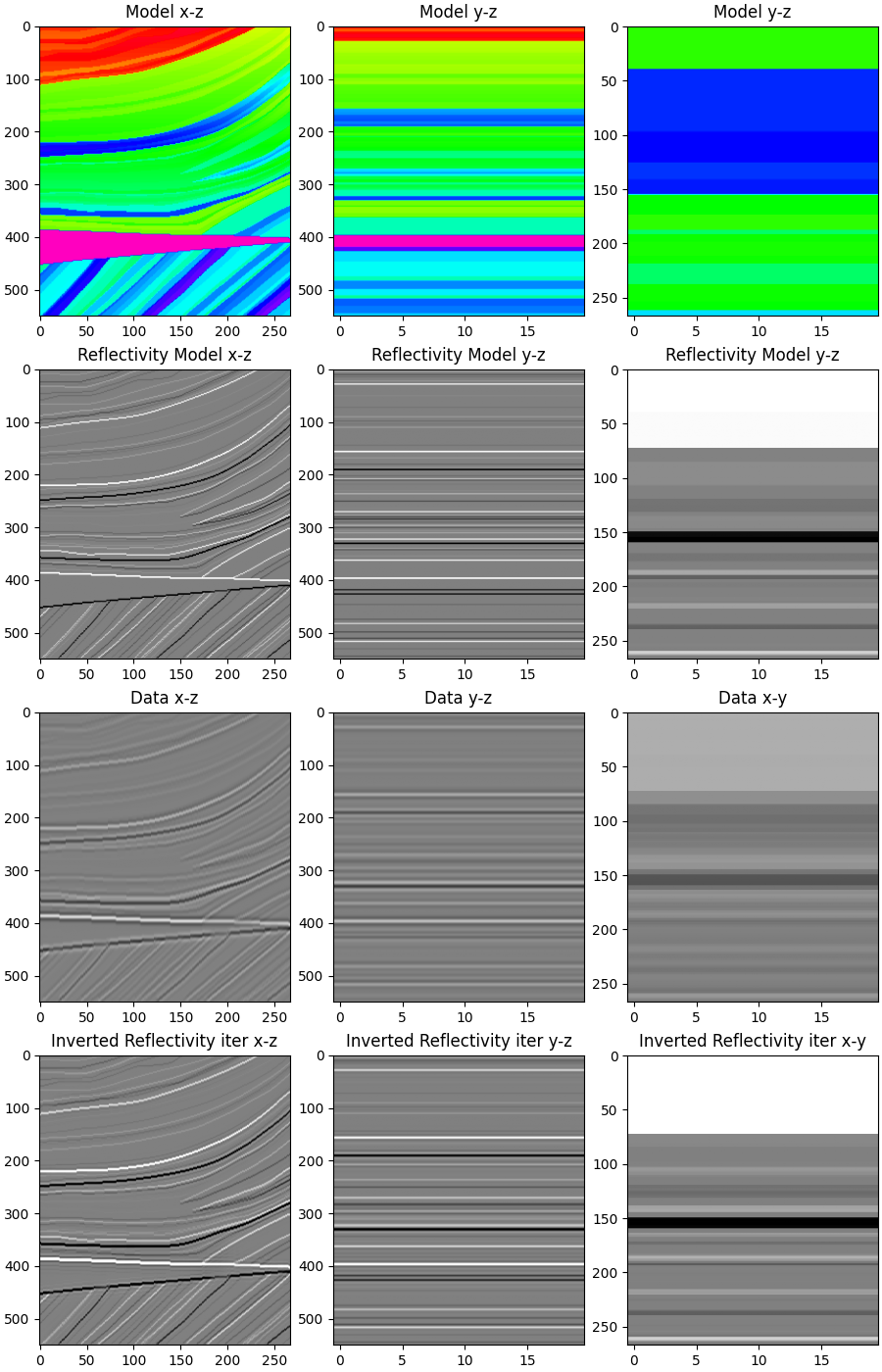
Reflectivity Distr == Local True
Data Distr == Local True
To run this tutorial with our NCCL backend, refer to Reflectivity Inversion with NCCL tutorial in the repository.
Total running time of the script: (1 minutes 31.549 seconds)